
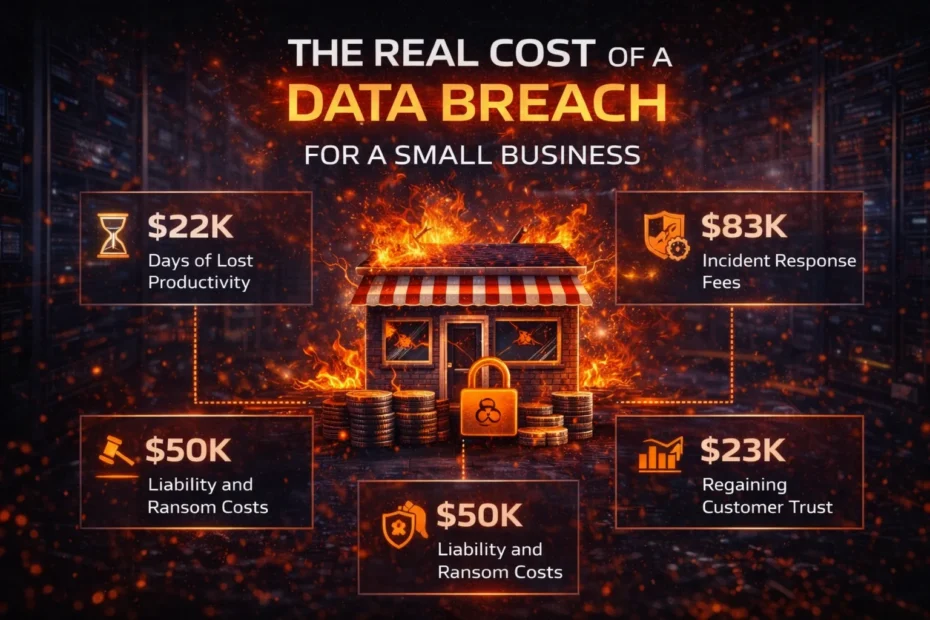
When partners think about the cost of a data breach for a small business, they usually think of the ransom. For a CA practice the ransom is rarely the biggest bill. The bigger costs are a week without the server in the middle of tax season, the clients whose PAN and bank details are now in someone else’s hands, and the legal duties that start the moment you notice. This post puts rupee terms on each of them, using published figures where they exist and a simple method where they do not.
Not legal advice. The legal figures below are maximums set by law as of October 2026; how they apply to your firm is a question for your legal advisor.
What the big studies say, and what they do not
The most quoted source is IBM’s annual Cost of a Data Breach report, researched by the Ponemon Institute. The figures most relevant to an Indian reader:
- India, 2026: an average of ₹25.5 crore per breach, up from ₹22 crore in the 2025 report. Phishing, including voice and SMS phishing, was the most common way in that IBM recorded in India (19%). Source: IBM India, August 2026.
- India, 2025: ₹22 crore on average, and 263 days on average to identify and contain a breach. Source: IBM India, August 2025.
- Worldwide, 2026: USD 4.99 million on average. Source: IBM, July 2026; the full report is at ibm.com/reports/data-breach.
A 12-person practice will not lose ₹25 crore. IBM’s figures are averages across the organisations in its study, and a small office’s bill will look very different. What carries over is the kind of cost: IBM counts detecting and investigating the breach, notifying people, responding afterwards and lost business. The 263 days matter too. The longer an intruder goes unnoticed, the more there is to clean up and the more data has left.
Cost 1: downtime, at the worst time of year
Attacks do not wait for a quiet month. If the Tally server and client folders are encrypted in ITR season or the week a GST return is due, your staff sit idle, filings slip, and clients face late fees and interest they did not cause. They will ask who pays.
You can estimate the staff part yourself. The example below uses round assumptions, not survey data; replace them with your own numbers.
| Line | How to work it out | Example (assumptions) |
|---|---|---|
| Staff who cannot work | Monthly staff cost ÷ working days × days down | 12 staff at ₹40,000 a month: ₹4.8 lakh ÷ 22 days ≈ ₹21,800 a day. Five days ≈ ₹1.1 lakh. |
| Overtime to catch up | Hours of overtime × your overtime rate | Your figure |
| IT recovery work | Your vendor’s emergency rate × days, plus any new hardware | Ask your vendor for the rate now, not during the incident |
| Client penalties you absorb | Late fees and interest on filings that slipped, if you choose to pay them | Depends on the client list and the dates |
| Partners’ time | Days spent on calls, reports and client conversations | Usually the largest hidden line |
The fastest way to shrink this table is a backup the attacker could not reach, plus a restore you have already tested. See how ransomware gets into Windows servers for what that looks like.
Cost 2: client confidentiality
A CA firm’s server holds what fraudsters want most: PAN and Aadhaar details, bank statements, salary records, and often the passwords clients have shared for the income-tax and GST portals. The Chartered Accountants Act treats disclosing information gained in a professional engagement without the client’s consent as professional misconduct (Second Schedule, Part I, Clause (1)). The penalties under section 21B range from a reprimand to removal from the register, or a fine of up to ₹5 lakh. Whether a theft from your server counts as your disclosure is a question for your advisor. Either way, clients and the Institute will ask what care you took.
Then there is the commercial side. A CA practice grows by referral. A breach that clients hear about from each other can cost more over the following years than anything on the invoice list above.
Cost 3: legal duties and penalties
| Law | Applies | Duty | Maximum consequence |
|---|---|---|---|
| CERT-In Directions, 28 April 2022 (IT Act s.70B(6)) | Now | Report specified incidents within 6 hours of noticing; keep logs for 180 days in India | Up to ₹1 crore, up to one year’s imprisonment, or both (s.70B(7)) |
| IT Act s.43A and SPDI Rules 2011 | Now, until mid-May 2027 | Reasonable security practices for sensitive personal data such as passwords and bank or card details | Compensation to the people affected |
| DPDP Act 2023 and DPDP Rules 2025 | Main duties from mid-May 2027 | Reasonable security safeguards (s.8(5)); tell the Data Protection Board and each affected person of a breach, with a detailed report within 72 hours | Up to ₹250 crore for failing to take safeguards; up to ₹200 crore for failing to notify |
Sources: the CERT-In Directions, the DPDP Act 2023 (section 8 and the Schedule) and the DPDP Rules 2025. The CERT-In fine was raised from ₹1 lakh to ₹1 crore by the Jan Vishwas Act from 30 November 2023. The DPDP Act omits section 43A on the day its main duties begin.
The DPDP figures are ceilings. When setting a penalty, the Data Protection Board must weigh the nature, gravity and duration of the breach, the kind of data, and whether the firm acted quickly and effectively to limit the damage (section 33(2)). That is exactly why a written security policy, kept logs and a quick, honest report matter: they are your evidence of reasonable care. Our incident response guide sets out the order of those reports.
Cost 4: the ransom, and why it is a poor bet
If ransomware is involved, someone will suggest paying. Paying does not guarantee working decryption, or that the copy the attackers took is deleted, and it does not remove their access. Verizon’s 2026 Data Breach Investigations Report found that 69% of ransomware victims in its data did not pay. Government agencies, including CISA, advise against it. Take expert and legal advice before any contact with the attackers.
What prevention costs by comparison
The controls that prevent most of the above are not expensive. Most cost time rather than money:
- Close Remote Desktop to the internet. Prixl Guard gives invited staff an encrypted tunnel to the server, with no static IP or router setup. The Warden + Guard plan includes 5 seats; extra seats start at ₹600 per person per year. A VPN or RD Gateway also works. Changing the RDP port is not a fix.
- Backups: three copies on two kinds of storage, one away from the office, one offline or immutable, and a restore test every quarter. The Tally company data comes first.
- Passwords of at least 15 characters and no reuse of portal passwords. See minimum password length.
- Monthly patching, and a plan for any server still on Windows Server 2016, whose support ends on 12 January 2027. See why regular updates matter.
- Someone watching the server. Prixl Warden reads the Windows event logs and emails you about brute-force campaigns, sign-ins outside working hours, new accounts, new services and the firewall being switched off, with a daily digest at 18:00 IST. Prices are on the pricing page.
Set those against one lost week in July and the arithmetic is not close. Start your 30-day free trial; no card is needed.